View only
they can see your reports and data.
Every share starts with a request, and it's entirely your call whether to say yes.
When a bank or processor asks for your numbers, the usual way to get them across is an email with a spreadsheet attached. Once you hit send, that file is out of your hands, and you can't see who it gets forwarded to or where it ends up saved.
Banks and supply chain businesses are unlikely to stop asking producers for data. Ruminati gives you a way to say yes to those requests while you stay in control of what's shared and who sees it.
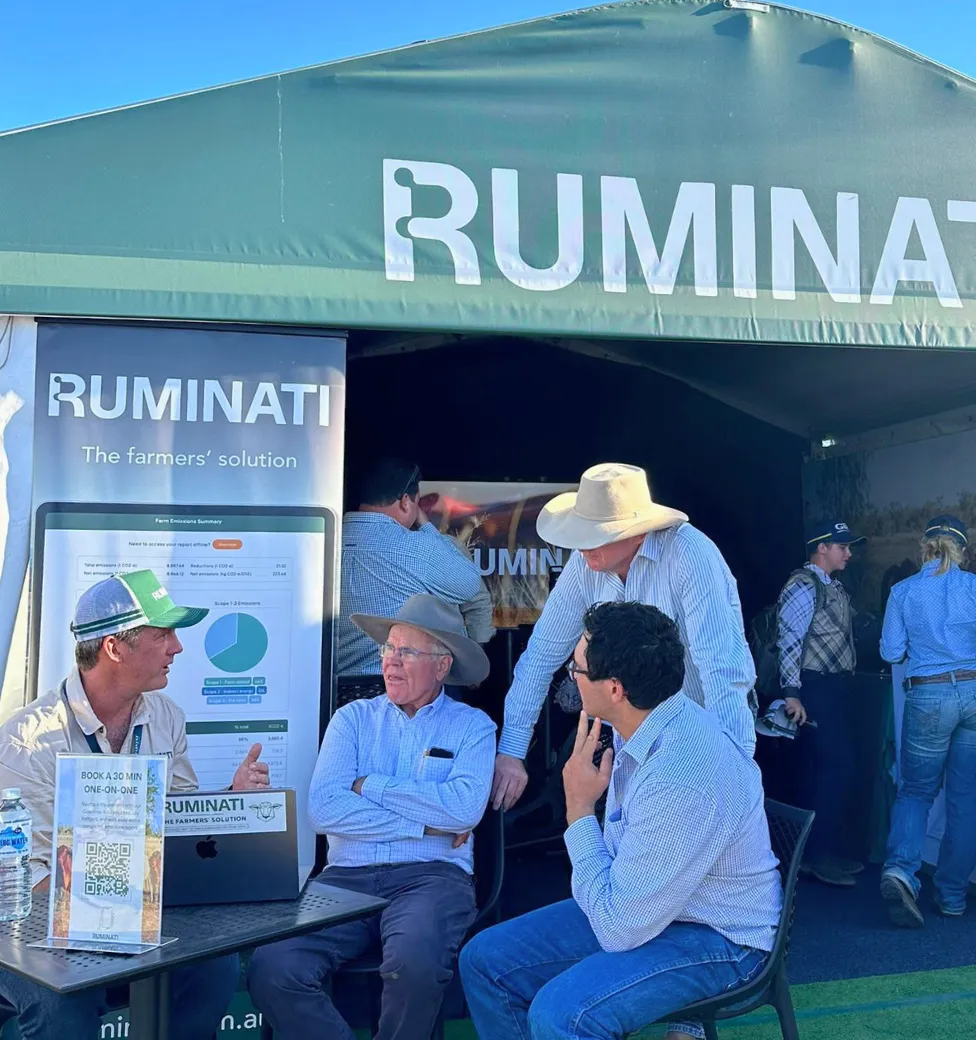
Ruminati is free for producers and advisors. The banks and supply chain businesses that use Ruminati VISION, the dashboard they use to receive the data producers choose to share, pay for access to the platform. That access doesn't give them any of your data. A business can only see your information if it asks you for it and you agree.
Requests arrive by email and also show up in your account under the Data Sharing tab. Ruminati shares nothing until you've said yes.
Each request has a link that says “see what's been requested”. It lists exactly what the business is asking for, drawn from these options:
Emissions report results
Emissions report inputs
Emissions reduction plan status
Deforestation status
Most emissions requests cover your summary results plus your enterprise name, location and email. Some businesses ask for more, including inputs, and the request will say so. Read each one before you agree.
Deforestation requests are listed separately, and only the status is shared. Cibo Labs carries out the deforestation assessment and Ruminati connects the result to your farm, so sharing it works the same way as everything else.
Only an organisation admin can approve a request. If a request lands with a team member who is a Report Manager or Report Viewer, an admin still has to be the one to agree to it.
The business sees your information in its VISION dashboard. Ruminati's Terms of Use apply to every business on the platform. They can use what you share for their own internal business purposes, and they can't pass it on, resell it or publish it online or in the press. VISION itself doesn't let a business share your information with others.
Advisors (accountants, bookkeepers, agronomists and consultants) can enter data, check it and create reports on your behalf, which is how a lot of producers prefer to do it.
There are two ways to connect. Your advisor can set up your farm in Ruminati and send you an email invite, and you accept it, create your account and choose how much access they get. If you already have a Ruminati account, you can send your advisor a data share request instead. They approve it and assign someone from their team to your farm.
You decide the level of access:
they can see your reports and data.
they can work on your reports directly.
they can also manage your properties and which of their own staff are connected to your farm.
Once you've linked a Cibo Labs deforestation assessment, an advisor connected to your farm can see its status too.
If you change advisors, you disconnect the old one and send a data share request to the new one. Once the old advisor is disconnected, they lose all access to your data, and anything they entered or edited stays in your account.
An organisation admin invites a team member, and the team member has to accept before they can see anything. The admin then sets their role.
Admins can change a role or remove someone at any time. Data in your account can only be used for your organisation's purposes, so a team member can't take it for personal use.
An organisation admin can turn off sharing with a business at any time from the Data Sharing tab, and from then on that business gets nothing new. Ruminati can't call back what a business has already seen, so the summary results you've shared stay with them.
You can delete your farm data yourself in the platform, either by removing the raw data inputs or by deleting the enterprise. You can also email hello@ruminati.com.au and ask for it. Summary data you've already shared with a business stays with them either way.
To close your account, email the same address. Ruminati processes the request within one business day, keeps your data for 30 days and then deletes it permanently. During those 30 days you can download your emissions report as a PDF. Raw farm data can't be downloaded at the moment.
When you use Ruminati, your information joins a pooled data set with other producers' information, with anything that identifies you or your property removed. Ruminati uses that pool to put together regional and industry-level insights, and those insights may be shared in anonymised form. Ruminati never attributes data or insights to you or your business without your direct and explicit say-so.
Joining the pool is part of signing up and is covered in the Terms of Use. Because the information is anonymised, it stays in the pool if you later delete your data or close your account.
Your farm data is stored and processed in Australia. Ruminati is a signatory to the National Farmers' Federation's Australian Farm Data Code and works to handle farm data in line with it. The full detail is in the Terms of Use and the Privacy Policy.
If you'd like any of this talked through, sing out at hello@ruminati.com.au.