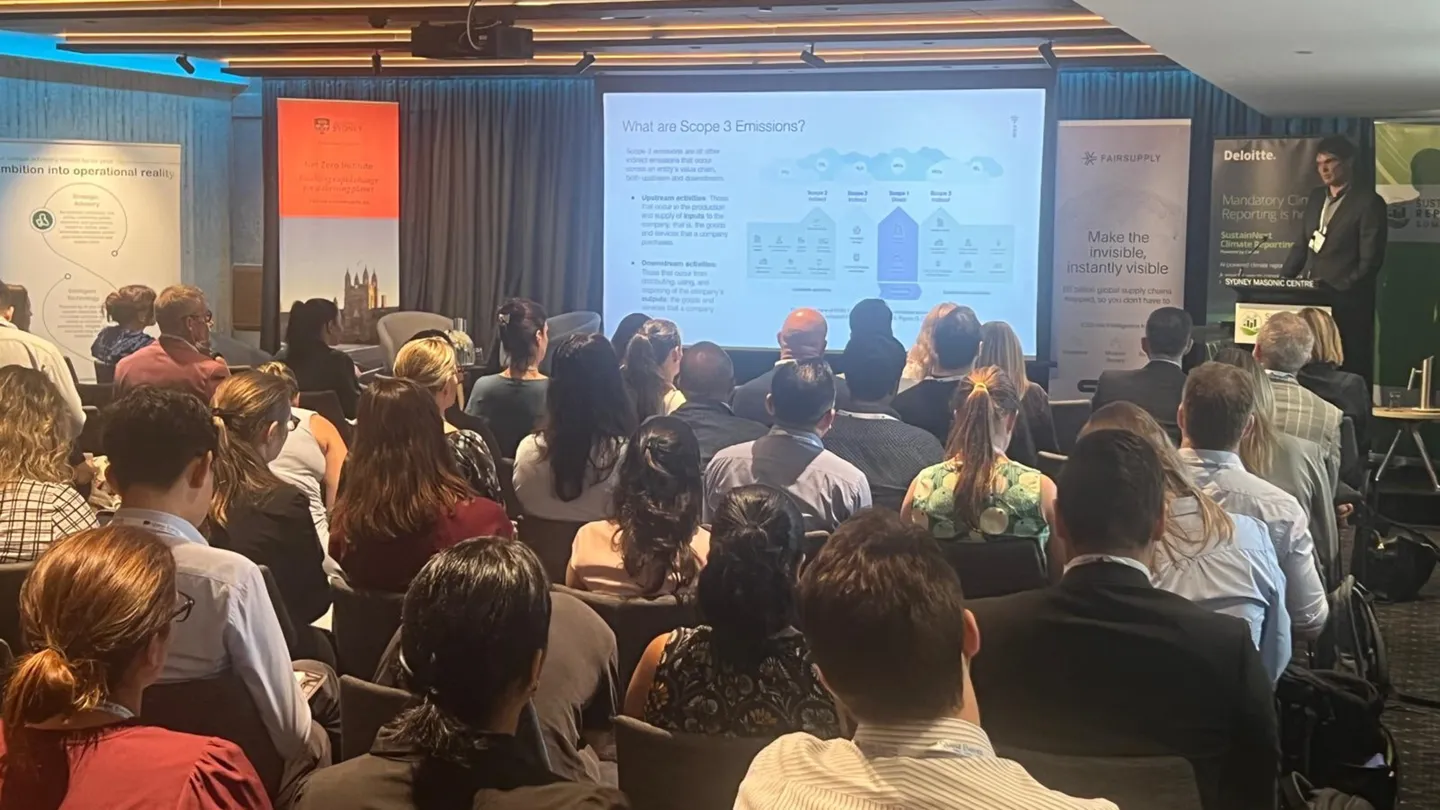
When an investor reads a company’s emissions figure, the number is the smaller part of what they are reading. A session at the Sustainability Reporting Summit with NAB’s Jordan Grace and Alphinity Investment Management’s Moana Nottage framed it well, which was that investors read emissions reporting for what it says about how a company is managing risk. Businesses that understand and track their emissions profile, and can show improvement over time, are starting to be viewed in the same way as companies with sound financial risk management, and the gap between a business with credible data behind its claims and one still working out what that looks like was easy to see across the summit.
The timing adds weight to that. Emma Verheijke of Collins Foods pointed out that mandatory reporting is already being rolled out across more than 30 jurisdictions globally, covering over 60% of global GDP, and many of the businesses at the summit expect to be reporting within the next 12 months.
For agriculture-linked businesses the harder part of that work sits further down the supply chain. These requirements fall on large businesses first, and a lot of the information underpinning them comes from the supply chains behind their products, which makes data from farms an increasing part of the strategy conversation in boardrooms. How that data is sourced decides how much it can show. Lawyer Kristen Roy, in an earlier Ruminati conversation about the new reporting rules, explained that estimates built on national averages make it hard to show any year-on-year reduction unless the national factor itself falls, whereas figures collected from suppliers can show a reduction when the farms in a supply chain change what they do.
The checking is tightening as well. In that conversation Kristen noted that reporting companies are held to limited assurance in the early years and move to reasonable assurance by 2030, which involves a deeper look at emissions data, processes and controls, and that puts weight on farm-level figures that can be traced and checked.
Those figures have to come from producers, and producers decide whether to share them. A farm’s emissions profile holds detailed information about how the business operates, so the questions producers ask about where it goes are fair ones, and they shape what a supply chain can reasonably ask for. Farm data stays with the producer, who chooses which organisations see it and can turn that access off at any time, and Ruminati is registered under the NFF Farm Data Code.
The businesses that understand how paddock data connects to boardroom strategy will be the best placed for what is coming. That connection is what Ruminati is built around, with farm-level figures built on regional emissions factors, kept in the producer’s hands and brought together across a supply chain with their permission.