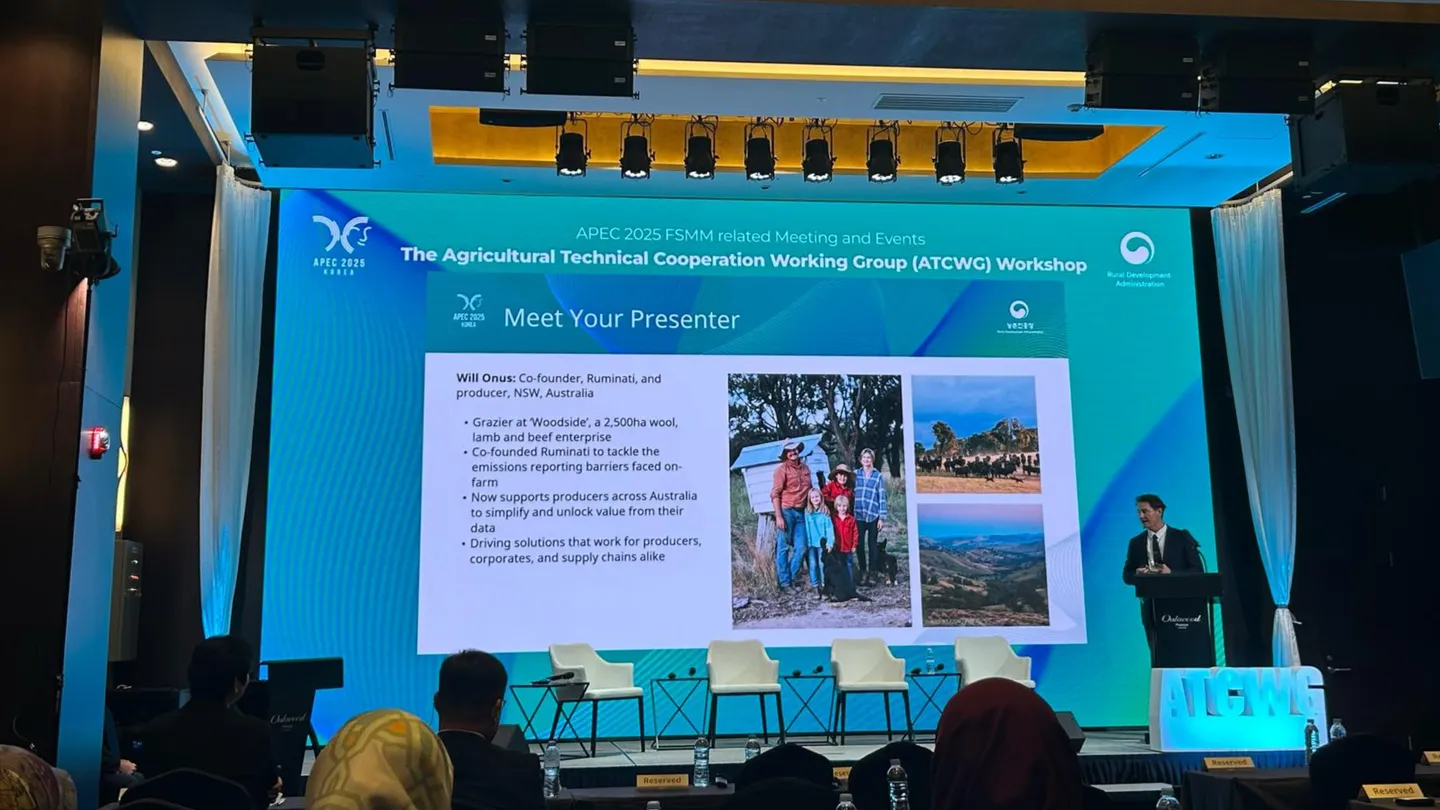
Most Australian producers first hear about emissions when a buyer or bank asks about them, and it is reasonable to wonder how widespread that ask is. The conversations at the APEC Food Security Ministerial Meeting in Incheon, South Korea, gave a clear answer, because the same ask is coming to producers in other countries too. Ruminati COO Will Onus joined the Australian delegation there last week, alongside representatives from DAFF, Tim Healey and Jeremy Collies from Artesian, and Katie McRobert from the Australian Farm Institute, and the week was built around how countries can share expertise and learn from each other’s approaches to agriculture. A visit to the National Agricultural Museum of Korea added some perspective on how different cultures have approached food production and land management over centuries.
Will presented in the Agricultural Technical Cooperation Working Group Workshop on what emissions technology is worth to a farm business, and the conversations afterwards made clear that the pressure is shared across countries, with producers being asked to show global markets what their emissions look like while keeping the farm commercially viable. That is a fair tension, because a farm only has so much time and money to put into this, and an emissions figure that costs the business something and returns nothing is a hard sell to anyone. It also means the questions reaching an Australian farm are part of how global markets are changing in every country that sells into them, and Australian farms are not being singled out.
Will’s argument in the workshop was that on-farm data can deliver emissions outcomes and business benefits at the same time, and for a farm business that is where the use is. The records you keep to see how efficiently the farm is running, such as livestock numbers and inputs, are the same records an emissions figure is built from, so the effort that goes into understanding the farm’s own efficiency also gives you something to work from when a buyer or bank asks. Those records stay yours, and who sees them is your decision.
“Australia’s got a great agricultural story to share,” Will reflected after the week. “But the real progress comes from learning together. By collaborating closely with other APEC economies, we can keep improving outcomes across the region.” A story like that is built from what happens on individual farms, which gives a producer a reason to know what their own records show before anyone asks.