Back to the Ruminati Journal
Efficiency gets a budget line. Compliance gets a working group.
Written by Ruminati Team on August 13, 2026
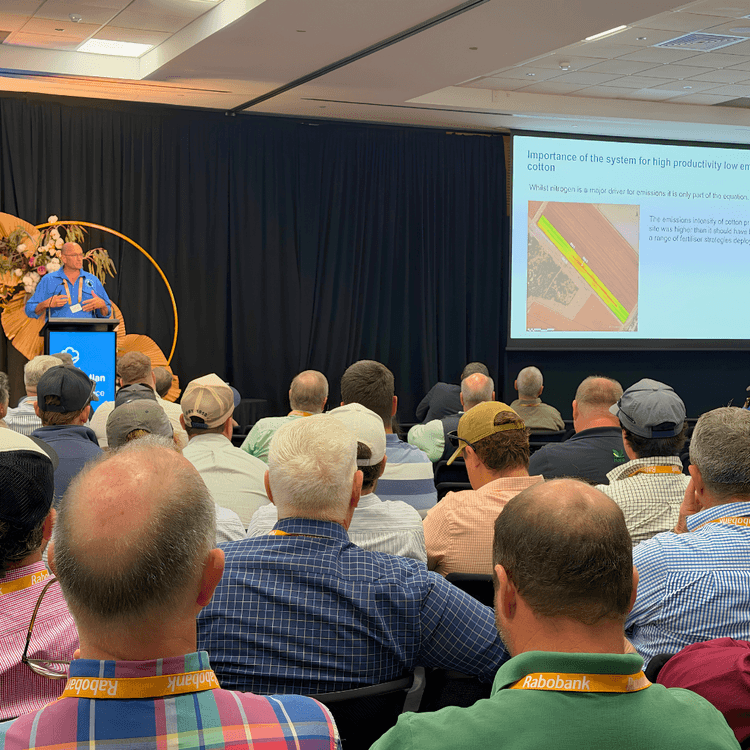
Our Strategy and Growth Manager Kara Hurry spent a few days at the Australian Cotton Conference on the Gold Coast recently, and came back with an observation the team has been discussing since.
One of the more unexpected topics to come up at the conference was bats. A property holding onto bat habitat is effectively buying pest suppression it doesn't have to spray for, something raised at the conference and backed by research presented there. It's not the kind of thing that usually ends up in a sustainability report, and most growers probably don't think of a stand of trees left standing as anything more than exactly that.
Nitrogen came up in a similar vein. Research shared at the conference put the figure at somewhere between 30 and 50 percent of applied nitrogen actually reaching the crop, with the rest lost somewhere along the way.
Kara's take on both examples was that they follow the same pattern in how they get discussed. Framed as an environmental outcome, something like bat habitat or nitrogen loss tends to end up in a report, discussed by a working group without much budget attached to it. Framed as an efficiency question though, the same fact gets a line item, because efficiency is a conversation most farm businesses are already having in some form.
Emissions intensity fits the same pattern. It's often talked about as a sustainability metric, but it’s also a productivity number under a different label: how much is coming out for what's going in. Cropping operations tend to run tight systems and think hard about input costs already, which makes the efficiency framing a fairly natural fit for how most cotton growers are already thinking about their business (once it's put in those terms).
There's a commercial angle to this specific to cotton. Australian cotton earns a premium above the global basis, and the sustainability credentials behind that premium are moving from a point of difference toward something closer to an expectation. Elizabeth Stott, Chair of Cotton Australia, raised a version of the grower's side of that question at the conference: more reporting tends to mean more cost, so what does a grower get back for it, and who controls the data behind it?
That second part doesn't have a clean answer yet, for cotton or for agriculture more broadly. Who owns farm data if the property changes hands, and what happens if a downstream claim turns out to be wrong, are genuinely open questions the industry hasn't settled. Anyone claiming otherwise is probably getting ahead of themselves.
Kara's framing is that an emissions baseline is a starting point: the first data point in an ongoing picture of how a system performs over time.
For cropping operations wanting to see where their own numbers sit, Ruminati PRIME is free to get started.