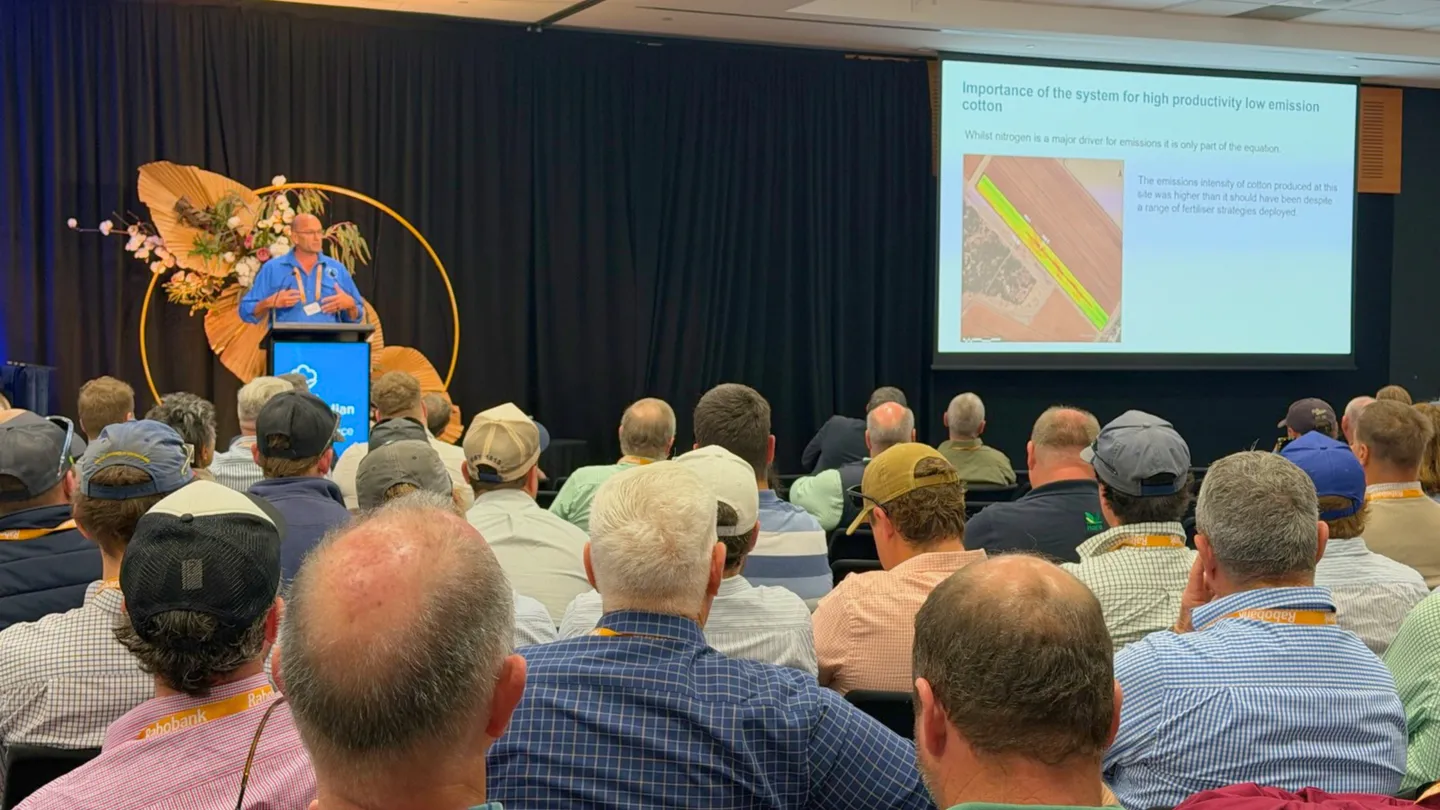
Reporting conversations about agriculture often carry an assumption that it is the sector everyone else is waiting on. Kara Hurry, our Strategy and Growth Manager, attended the AICD and Climate Governance Initiative Australia’s Climate Governance Forum, where a session on Australia’s transition put that assumption beside the Climate Change Authority’s own tracking.
Amandine Denis-Ryan, CEO of IEEFA Australia, presented the Authority’s progress by sector against the 2030 and 2035 targets. Of the six sectors, Land and Power were rated amber, Transport and Buildings orange, and Industry and Exports red, which made those two the furthest behind. On that tracking, Land sits ahead of Industry and ahead of Exports.
The same session set out the limits of that position. Amber still means behind schedule, and Australia’s overall decarbonisation rate needs to roughly double from its current level to reach the 2030 target, with Land having ground to make up alongside every other sector.
For a business with agricultural producers in its supply chain or lending book, the ratings give a sourced reference point when the question of where agriculture sits comes up, whether from a board or from an investor. They describe the national position by sector. They do not describe the producers a given business works with.
Movement within a particular group of producers shows only in figures collected from those producers. A national average cannot show a reduction unless the national factor itself falls, so a business reporting on its own producers needs farm-level figures to see change in its own position, whatever the sector rating shows. The rating frames the conversation, and the figures from a business’s own producers carry it forward.
Ruminati sits at that producer end, calculating farm-level emissions to the national guidance, which Ruminati implements and does not set. Producers own their data and choose who sees it, so what a business receives is what its producers have agreed to share.