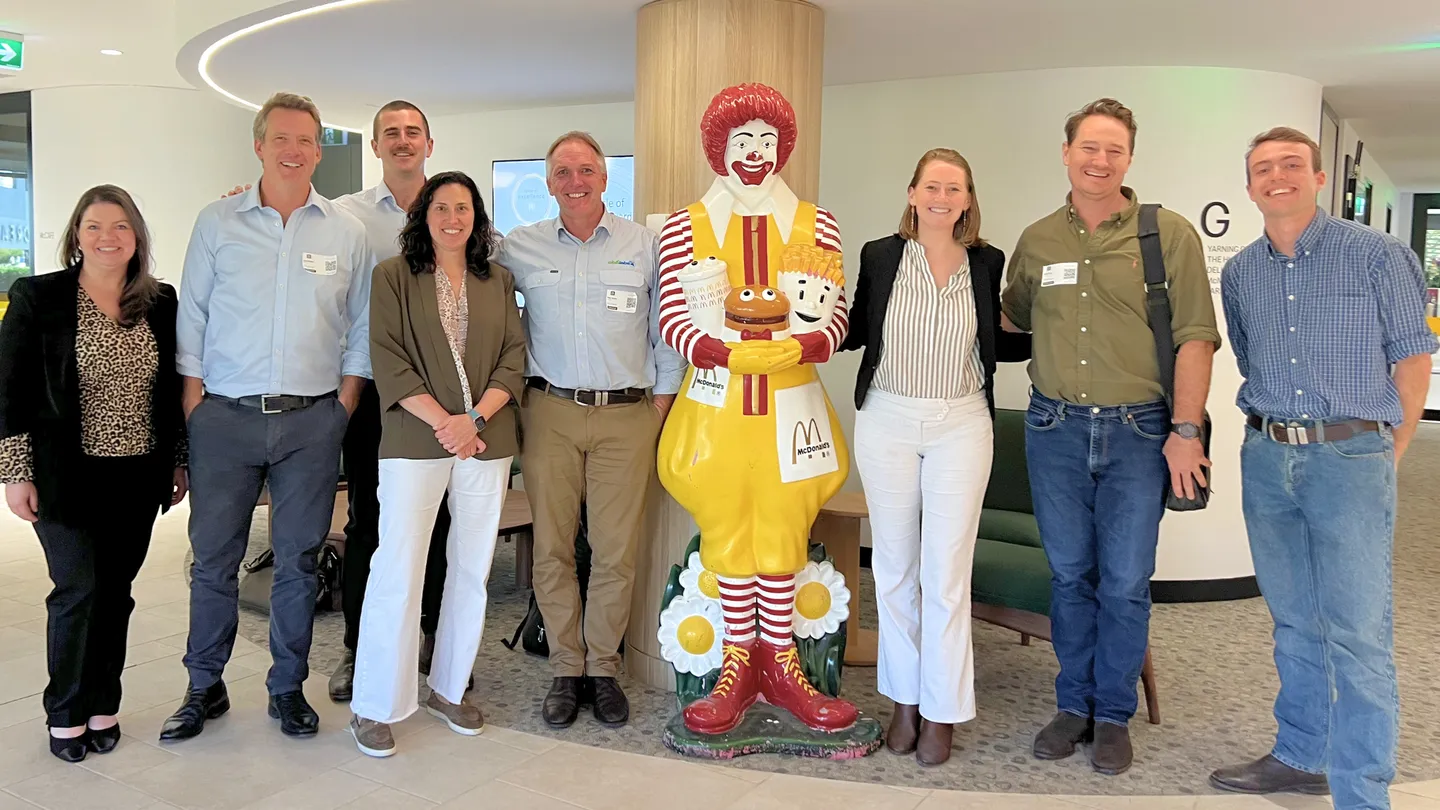
Technology and reporting frameworks only go as far as they make sense in the paddock, and adoption follows value, which is the view Ruminati COO Will Onus keeps coming back to in conversations with supply chains as a cattle producer himself. It ran through a meeting in Sydney this week with the McDonald’s team, who had flown in from Chicago at the tail end of a trip through their Australian supply chain, where Will was joined by Ruminati co-founder and CEO Bobby Miller.
The McDonald’s team arrived without a predetermined framework to present, and the focus was on listening to what supports productivity and environmental results on a farm and what gets in the way, and to where a business like McDonald’s can usefully help to solve it. It made for a more honest exchange, and it puts the producer’s side first, which is where Will’s point leads. If the benefit does not land back with the producer, a program stays a good idea in a presentation and goes no further, so the useful question for any business working with producers is what the benefit looks like on the farm.
From the producer’s side, value has two parts. The first is what the farm gets from its own figures. Emissions intensity moves with the same decisions a producer already weighs for profitability, and annual records show whether a change to the grazing system or fertiliser use moved the result, which makes the figures a feedback loop for running the farm quite apart from any request from outside. The second is what comes back from the supply chain, which is starting to take shape in insetting programs that recognise measurable emissions reductions and support efficiency, alongside longer-term supply relationships with farms that can show credible, data-backed performance. Insetting is still early in Australian agriculture, though the direction is clear.
What gets in the way is equally practical. On visits to dairy farms in Western Australia, Ruminati heard that the same details about a herd and a farm can end up written out again each time another business asks for a report, and that a tool adding to the admin load will not last long on a working farm. The other obstacle is control. A farm’s emissions profile holds detailed information about how the business operates, so the questions producers ask about where it goes are fair ones, and on Ruminati the data stays with the producer, who chooses which organisations see it and can turn that access off at any time.
Together those make a usable test for a business designing its own program, which is whether the producer sees their own figures and a return that justifies the effort, and whether it is clear where the data goes.
The meeting was also a chance to share some of the emissions and deforestation work being developed in Australia, with Phil Tickle from Cibo Labs at the table, and there is more locally grounded thinking here than often gets recognised internationally. Across emissions technology and the monitoring of land, including deforestation and natural capital, the common thread is that scale comes when the people doing the work on the ground can see what is in it for them. That makes the most useful first question a supply chain can put to a producer a simple one, which is what would make this worth doing on their farm.